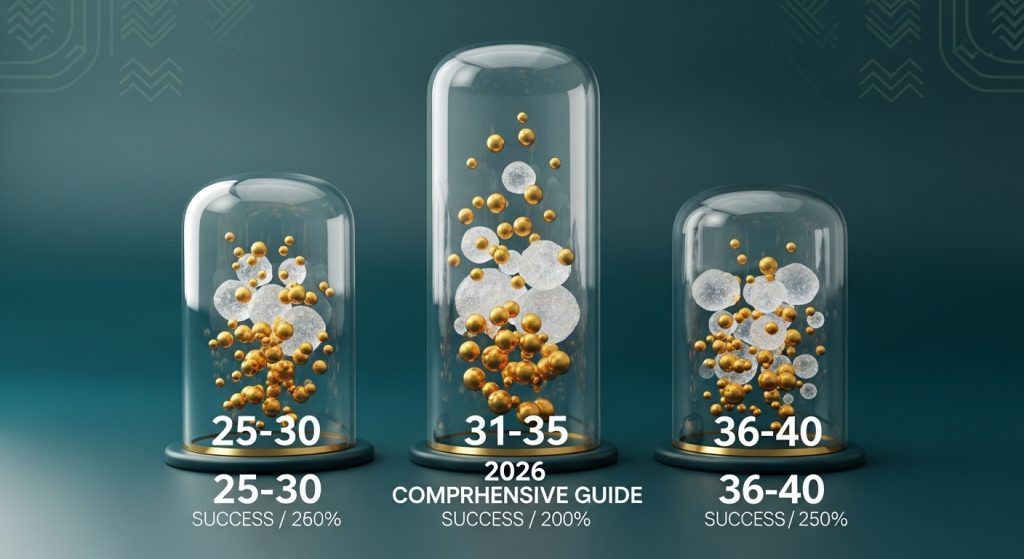
For many women in Nigeria, the decision to freeze eggs is an act of empowerment—a way to “pause” the biological clock while focusing on career, education, or finding the right partner. However, the most critical question remains: What are the actual egg freezing success rates by age, and is the investment worth it?
In this guide, we break down the latest clinical data for 2026, the realities of egg thawing success rates, and a transparent look at the egg freezing cost in Nigeria.

The Critical Link: Egg Freezing Success Rates by Age
The single most important factor in fertility preservation is the age at which you retrieve and freeze your eggs. This is because both egg quantity and quality decline naturally over time.
1. Freezing Before Age 35
This is the “Golden Window.” At this stage, eggs are typically chromosomally healthy (euploid).
- Success Rate: Women who freeze 10–15 eggs before age 35 have an estimated 70% to 80% chance of at least one live birth later in life.
- Key Advantage: You usually need fewer retrieval cycles to reach an optimal “bank” of eggs.
2. Freezing Ages 35–37
Fertility begins to dip more noticeably here, but success is still very achievable.
- Success Rate: The probability of a live birth per cycle is approximately 40% to 50%.
- Strategy: Doctors often recommend freezing 15–20 eggs to maintain a high probability of success.
3. Freezing Ages 38–40
While many women successfully freeze eggs in their late 30s, the “attrition rate” is higher.
- Success Rate: Live birth rates drop to roughly 20% to 30%.
- Challenge: A higher percentage of eggs may be chromosomally abnormal, meaning you may require multiple cycles to secure enough viable eggs.


Beyond Freezing: Understanding Egg Thawing Success Rates
Freezing is only half the battle. The true test of a fertility clinic’s technology is its egg thawing success rates. Modern “Vitrification” (flash-freezing) has revolutionized this. [Image of egg vitrification process]
Currently, leading Nigerian clinics report that over 85% to 90% of eggs survive the thawing process. However, survival does not equal fertilization. Once thawed, the eggs must be fertilized via ICSI (Intracytoplasmic Sperm Injection) to create embryos.
What is the Egg Freezing Cost in Nigeria for 2026?
Financial planning is essential. The cost of egg freezing in Nigeria varies based on the clinic’s location (Lagos vs. Abuja) and medications.
Estimated Price Breakdown (2026):
| Service | Estimated Cost (₦) |
|---|---|
| Initial Consultation & Scans | ₦50,000 – ₦150,000 |
| Hormonal Medications | ₦500,000 – ₦1,200,000 |
| Retrieval & Laboratory Fees | ₦800,000 – ₦1,800,000 |
| Annual Storage | ₦150,000 – ₦300,000 |
On average, the total cost in Nigeria 2026 for a single cycle ranges between ₦1.5 Million and ₦3.5 Million.
Pro Tip: Many clinics offer “Cycle Bundles” which can significantly reduce the cost of multiple retrievals.